
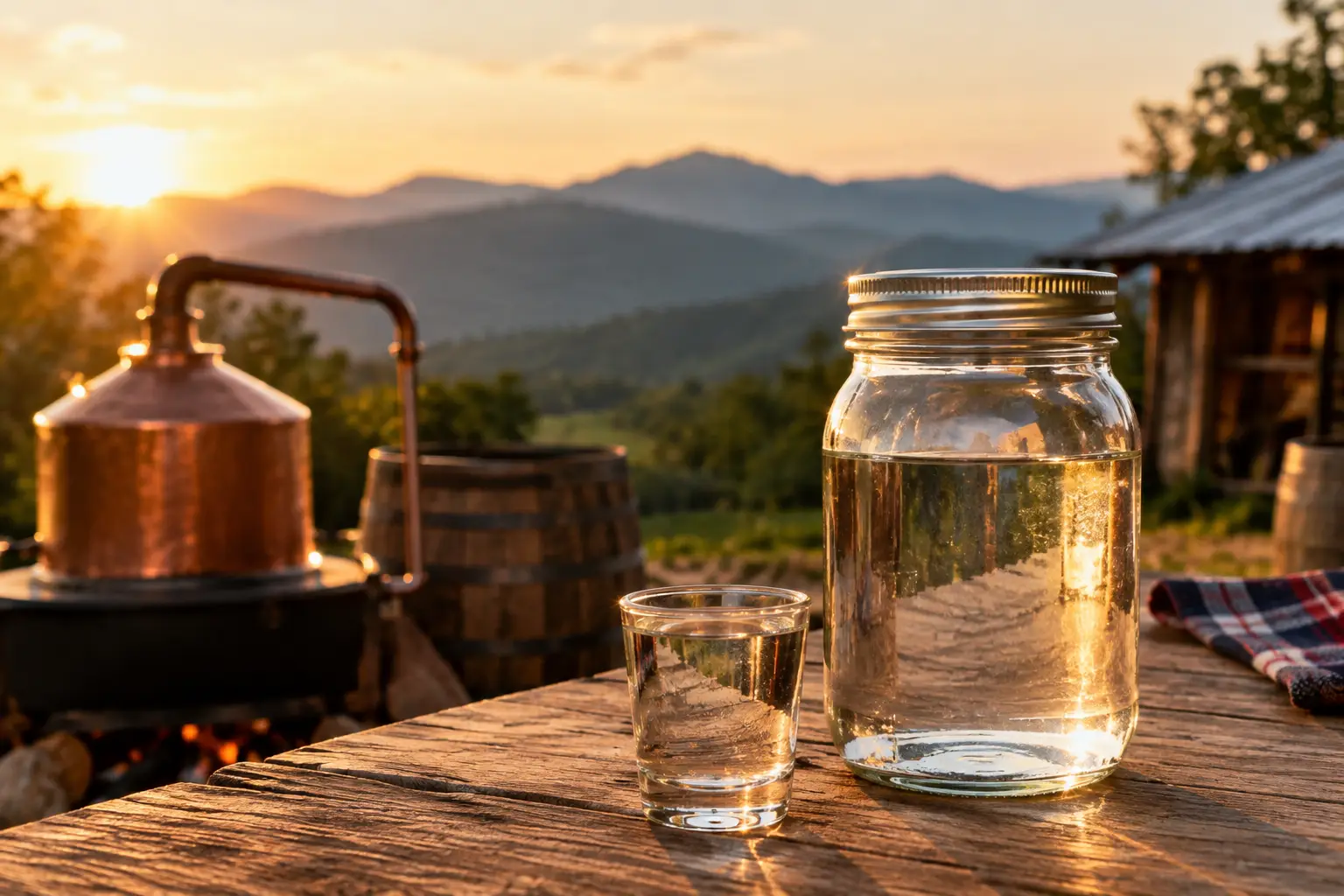
That mason jar with a handwritten-looking label may have all the backwoods charm in the world, but charm is not a liquor license. Knowing how to identify legal moonshine means looking past the corn-cob nostalgia and checking whether there is a real, accountable distillery behind the bottle. A good legal shine can honor mountain heritage, family stories, and old-fashioned craft. It should not leave you guessing what is in the jar or whether a friend just handed you a federal headache.
Moonshine has a proud place in American history, from Appalachian hollers to farm country across the Midwest and beyond. But the word itself can fool folks. Today, plenty of licensed distilleries legally sell clear corn whiskey and other spirits under the name “moonshine.” Meanwhile, homemade distilled liquor sold outside the legal system is still illegal, no matter how sweet Aunt So-and-So says it tastes.
What Makes Moonshine Legal?
Legal moonshine is distilled spirits made and sold by a properly licensed producer and distributed through legal channels under applicable federal, state, and local rules. That is the plainspoken version.
A legitimate distillery has approvals to make beverage alcohol, follows labeling and tax rules, and sells through channels allowed in its state. Depending on the state, that might mean buying directly at a distillery, at a licensed liquor store, or from an approved retailer. The exact rules can vary quite a bit. Some states welcome distillery sales with open arms; others have stricter rules about where spirits can be sold, shipped, or carried.
The big point is this: legal moonshine is not defined by whether it comes in a glass jar. A mason jar is packaging. It is not paperwork. Good Lord, you can put sweet tea, pickles, or questionable garden salsa in a mason jar too. The jar does not make it legal.
How to Identify Legal Moonshine on the Label
Start with the label, because a lawful producer should be willing to tell you exactly who made the spirit. You are looking for more than a clever name, a cartoon possum, and a line about Grandpa’s secret recipe.
A legal bottle or jar should clearly identify the distillery or company responsible for the product. Look for a producer name and location, along with a brand name that is easy to read. It should also state the alcohol content, usually as alcohol by volume or ABV, and the amount of liquid in the container. Legitimate distilled spirits packaging typically carries a government health warning as well.
The label should look intentional, but that does not mean every legal moonshine needs to look fancy. Plenty of small craft distilleries lean into a rustic, old-timey style, and rightly so. What matters is whether the required information is present, readable, and specific. “Made somewhere in the mountains” is a fine song lyric, but it is not a producer address.
Be cautious if the container has no label, a vague handwritten label, or only a first name such as “Ray’s Apple Pie.” Those details do not automatically prove anything, but they should make you pause. A legal producer has a name to stand behind, and a lawful product has information a customer can verify.
Also check the seal and closure. A factory-style tamper seal, shrink band, or properly closed cap is a reassuring sign that the product was packaged for retail sale. It is not a guarantee by itself, because anybody can buy jars and seals. Still, an unsealed jar that has been passed around a cookout cooler is not the same thing as a retail product from a licensed distillery.
Do Not Judge by Proof Alone
High proof does not mean illegal, and lower proof does not automatically mean safe or legal. Many legal moonshines are bottled at 80 proof, 100 proof, or higher. Some flavored products are lower. The ABV should be plainly stated, which lets adults make informed choices and handle the product responsibly.
A missing ABV is a bigger concern than a high one. If nobody can tell you how strong it is, you have no business treating it like a measured commercial spirit. Country folks know better than to gamble with what goes in the glass.
Buy From a Seller Who Can Answer Straight
Where you buy it matters nearly as much as what is printed on it. The cleanest route is purchasing directly from a licensed distillery, an established liquor store, or another authorized alcohol retailer. These businesses have licenses, records, and a reputation to protect. If something is wrong, there is a real place to take the question.
A legitimate seller should not get squirrelly when you ask who made the product, where it was bottled, or whether it is legally sold in that state. They should be able to provide a receipt, too. That little receipt may not look glamorous, but it is a whole lot more useful than, “My buddy knows a guy.”
Be especially careful with social media offers, parking-lot handoffs, flea market tables, and jars sold from the back of a truck. A seller saying, “It is just for a donation,” does not turn an unlawful sale into a legal one. Bless their heart, creative wording is not a permit.
Real Heritage Does Not Need a Tall Tale
Legal distilleries often celebrate moonshine history, and they should. The old stories are part of the fabric of rural America: resourceful families, hard times, stubborn independence, and the folks who made a living where they could. But a good heritage brand can tell that story without pretending its product was cooked up last night beside a creek.
Read the claims with a clear eye. Terms like “small batch,” “handcrafted,” “mountain style,” and “old family recipe” may describe a product’s inspiration or production style, but they do not replace licensing. A genuine distillery will usually be proud to share where it operates and what it makes. That is the difference between celebrating tradition and using tradition as camouflage.
There is also no shame in buying legal shine from outside Appalachia or the South. Fine distillers are making corn whiskey and moonshine-style spirits in farm towns, mountain communities, and small cities all over America. Country heritage travels well when it is carried with honesty.
What Will Not Reliably Tell You
A few old-fashioned “tests” get repeated around campfires, but none of them can prove a jar is legal or safe. Smell, color, bubbles, flames, taste, and whether a fruit floats in it are not reliable legal checks. More importantly, tasting an unknown spirit to investigate it is a mighty poor plan.
Clear liquor can be a legal corn whiskey, vodka, neutral spirit, or something else entirely. Flavored liquor can be professionally bottled, or it can be a mystery in a mason jar. The look of the liquid tells you far less than the label, seal, seller, and source.
Do not assume that a tax stamp proves everything either. Tax markings and bottle requirements are not identical in every state, and counterfeit packaging exists. Think of every clue as part of the picture. The strongest combination is a clearly labeled product, a known licensed producer, a sealed container, and a lawful retailer.
State Lines Can Change the Rules
Even when the moonshine itself was legally made, the rules around buying, transporting, and shipping alcohol can change from one state to the next. Direct shipping rules are especially uneven, and dry counties or local restrictions can add another wrinkle. What is sold legally at a distillery gift shop may not be lawful to mail or resell somewhere else.
If you are bringing back a bottle from a road trip, keep it sealed, keep your receipt, and check the rules for your destination before treating it like any other souvenir. A legal purchase deserves legal handling all the way home.
If You Are Still Not Sure, Leave It Alone
When the story is fuzzy, the label is missing, or the seller cannot give a straight answer, the best move is simple: do not drink it and do not buy it. There is no prize for being the brave soul who samples a mystery jar. There are too many excellent legal distilleries making honest, flavorful spirits to take that kind of gamble.
Ask the retailer for details, contact the producer listed on the packaging if there is one, or check with your state’s alcohol control authority when a sale seems questionable. If a product appears tampered with or falsely labeled, set it aside rather than passing it along to somebody else.
The best moonshine story is one you can tell with a grin the next morning: good people, good company, a real distillery, and no trouble riding shotgun. That is country hospitality with its boots on straight.