
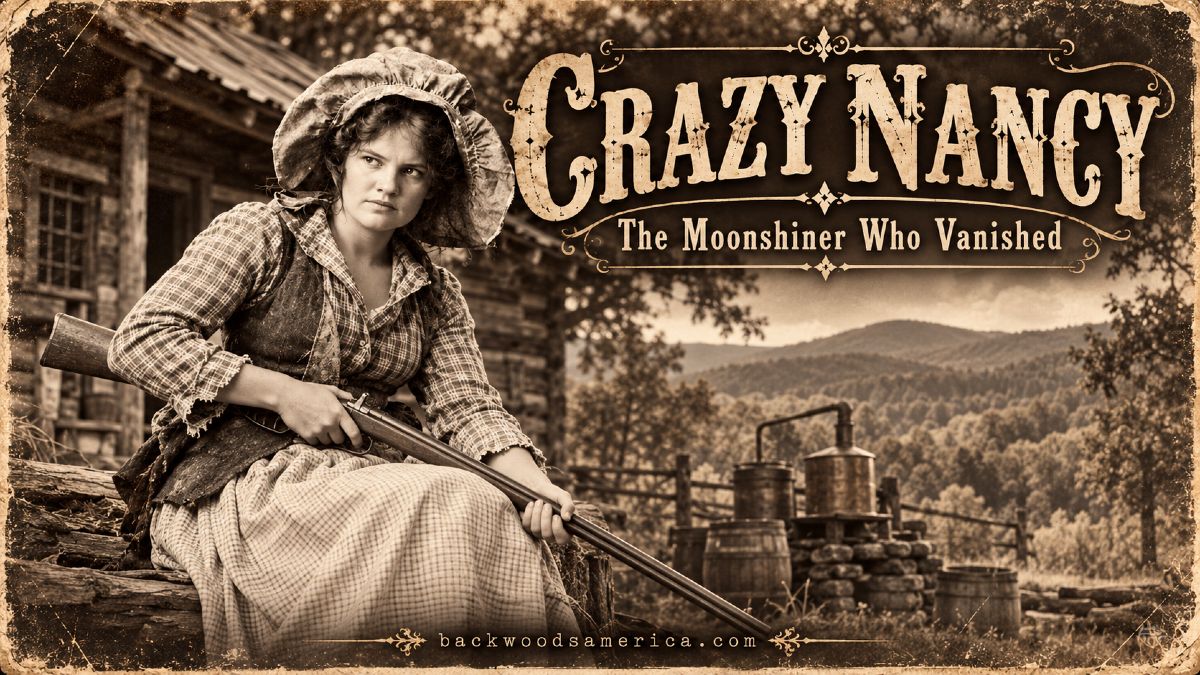
They called her crazy. They called her strange. But deep in the New Jersey hills, one mysterious woman was reportedly running a moonshine operation so well hidden that even the government couldn’t figure out what she was up to. And when the law finally caught on, they discovered that Crazy Nancy wasn’t nearly as foolish as folks believed.
Some of America’s greatest backwoods stories aren’t found in fancy history books or hanging on museum walls. They’re tucked away in old newspaper clippings, passed down through generations, and whispered about in little country towns where everybody knows everybody’s business. And every once in a while, a story comes along that’s so wild you almost have to wonder if somebody’s pulling your leg. That’s certainly the case with a mysterious woman known only as “Crazy Nancy,” a moonshiner whose reported exploits in the hills of Warren County, New Jersey, became the stuff of legend.
Long before the days of nationwide Prohibition, back when revenuers were already chasing illegal whiskey makers through America’s mountains and hollers, Nancy was said to be living alone in a secluded little building along Pequest Creek. Nobody seemed to know where she came from, what her real name was, or much of anything about her past. She kept to herself, didn’t appear interested in making friends, and had a reputation for being a little peculiar. The locals called her Crazy Nancy, but as the story goes, that nickname may have said a whole lot more about what folks thought of her than about the woman herself.
During the warmer months, Nancy could be found selling wild berries around the neighboring communities. When winter rolled around, she trapped animals, hunted game, and sold whatever furs and meat she could gather. To most folks, she looked like another backwoods woman scratching out a living from the land. But there was something about Nancy that didn’t quite add up. Despite her seemingly modest income, she always appeared to have money, and the same woman people dismissed as simple-minded could reportedly bargain like a seasoned businessman. She might not have impressed folks with fancy clothes or a polished education, but she apparently knew the value of a dollar.
There was another mystery surrounding Nancy. Every winter, she would disappear for several weeks, only to return as though nothing unusual had happened. Nobody knew where she went, and Nancy certainly wasn’t offering explanations. Meanwhile, farmers in the surrounding countryside had begun noticing something mighty troubling. Apples were disappearing from their orchards, and rumors were spreading that someone in the county was running an illegal moonshine business on a surprisingly large scale.
Now, here’s where this story starts getting mighty interesting.
According to a newspaper account published in January 1896, government officials became suspicious and sent a detective named Finch to investigate. He reportedly took a job as a farmhand a couple of miles from Nancy’s home, giving himself an excuse to remain in the area while keeping an eye on the mysterious woman. For weeks, he watched, waited, and tried to figure out exactly what was happening. Nancy wasn’t particularly friendly, and she apparently had no interest in entertaining strangers unless they were there to buy something.
One cold night, Finch allegedly spotted a man approaching Nancy’s place carrying a heavy sack. The stranger entered the building, but Finch never saw him leave. That was enough to convince the detective that something unusual was going on. He suspected the sack contained stolen apples, possibly destined for an illegal still, and wondered whether Nancy had a male accomplice helping her operate the business.
Eventually, Finch decided to investigate the building while Nancy was away. According to the old account, he managed to get inside and discovered what appeared to be an ordinary, sparsely furnished country dwelling. There were a few chairs, a table, a fireplace, and some dried apples hanging nearby. Nothing especially remarkable. But hidden above the main room was a passage leading into the hillside, where Nancy had supposedly concealed an entire moonshine operation.
And that wasn’t all.
Inside the hidden chamber, Finch reportedly discovered a still, dozens of large jugs, and a considerable supply of apples. He also found women’s clothing lying nearby. The mysterious man he’d seen entering the building hadn’t necessarily been an accomplice at all. According to the story, it was Nancy herself, dressed in men’s clothing to carry on her business without attracting attention.
Just think about that for a minute. In an era when women had far fewer opportunities and were often underestimated, this mysterious mountain woman was supposedly using other people’s assumptions to her advantage. Folks believed she was harmless, eccentric, and perhaps not too bright. Meanwhile, the newspaper portrayed her as someone clever enough to keep a sizable illegal operation hidden right under their noses.
But the story wasn’t finished.
Instead of quietly leaving and returning with help, Finch reportedly decided to wait inside Nancy’s home and arrest her himself. He concealed himself beneath a table until she returned later that night. When the detective emerged and ordered her to surrender, Nancy reacted in a way he apparently hadn’t expected.
As the old newspaper told it, she blew out the candle, plunging the room into darkness. Finch fired his revolver, but the shot missed. Before he could recover, Nancy struck him in the face with a stool, rushed through the doorway, and disappeared into the night.
And just like that, Crazy Nancy was gone.
When authorities searched the property afterward, the account claimed they discovered approximately 500 gallons of applejack, hidden in jugs beneath the floor and inside a nearby cavern. The newspaper also suggested that Nancy may have shipped her illegal liquor to markets in Philadelphia and New York, concealing the containers among ordinary goods such as nuts and animal hides. That part of the story was presented as suspicion rather than something investigators had definitively established.
As for Nancy herself, the newspaper claimed she was never captured and that her true identity remained a mystery.
Now, we ought to remember something important about stories like this. The account was published in 1896 and described events said to have happened roughly ten years earlier. Newspapers of that era weren’t always shy about adding a little drama to a good outlaw tale, especially one involving hidden treasure, a mysterious woman, and a lawman getting outsmarted. Without additional independent records, we can’t say with certainty that every detail happened exactly as reported. But the fact that such a story was circulating more than 130 years ago is remarkable in its own right.
And there’s a bigger lesson hiding beneath all those colorful details.
How many strong, independent women throughout American history were dismissed simply because they didn’t behave the way society expected? How many were called strange because they preferred solitude, stubborn because they refused to surrender their independence, or foolish because nobody bothered to understand them? We don’t know enough about Nancy’s personal life to say exactly what drove her, but the story surrounding her is a reminder that appearances can be mighty deceiving.
Here at Backwoods America, we’ve always believed there’s a special kind of wisdom that comes from learning to survive with your own two hands. It’s the knowledge passed down through generations of farmers, trappers, mountain families, woodsmen, and ordinary country folks who had to figure things out without the luxuries we take for granted today. They knew how to make use of the land, endure rough weather, stretch limited resources, and keep going when life got difficult.
That doesn’t mean every decision our ancestors made was right. Illegal distilling carried risks, and breaking the law had consequences. But understanding the people behind these stories means recognizing that early American life could be complicated, and the line between necessity, independence, opportunity, and outright rebellion wasn’t always as simple as a newspaper headline made it sound.
Crazy Nancy’s story also reminds us of something else: history hasn’t always given women their rightful place in the telling of America’s backwoods heritage. When folks talk about moonshining, the conversation usually turns to bearded men tending copper stills in hidden hollers. But women were part of that history, too. They farmed, traded, supported their families, made liquor, operated businesses, and sometimes challenged the authorities just as boldly as the men whose names became famous.
Nancy may never have known that people would still be discussing her more than a century later. We don’t know where she spent her final years, whether she ever settled down under another name, or whether anyone close to her knew the full story. As far as the available historical account goes, her life fades back into the same mystery from which she first appeared.
But perhaps that’s what makes the legend so unforgettable.
A woman who lived quietly in the hills, kept her business to herself, and was underestimated by nearly everyone around her supposedly managed to leave one determined detective empty-handed and a whole lot of people scratching their heads.
Maybe some of those details grew taller with every telling. That’s the nature of old country legends. But beneath the mystery is a story about independence, ingenuity, and the danger of assuming you know somebody simply because of how they look or live.
At Backwoods America, we believe those forgotten stories deserve a place alongside the better-known chapters of American history. Not because every outlaw deserves to be celebrated, but because understanding our past means remembering the people who lived outside the ordinary boundaries of their time.
The backwoods have always been full of people who marched to their own drum, worked with what they had, and weren’t particularly interested in being told how to live. Some became heroes, some became outlaws, and others became legends whose true stories may never be completely known.
As for Crazy Nancy, we may never know her real name or what happened after that cold night in the New Jersey hills. But more than a century later, the tale of the mysterious moonshiner who allegedly fooled the revenuers still has the power to entertain, inspire curiosity, and remind us that some of America’s most fascinating stories belong to people history nearly forgot.
They called her Crazy Nancy. But if even half that old newspaper story is true, she just might have been crazy like a fox.
And somewhere in those hills, her legend lives on.
Keeping America’s Forgotten Stories Alive
Here at Backwoods America, we’re proud to preserve the stories of the people, traditions, and forgotten characters who helped shape this country. Some stories are inspiring, some are heartbreaking, and some are so unbelievable that you’d swear they came straight out of a country storyteller’s imagination.
But they all remind us of something important: America’s history belongs to everyday people, too.
Did your grandparents ever tell you about an old moonshiner, a mysterious neighbor, or a local outlaw who supposedly outsmarted the law? Maybe there’s a story from your hometown that’s been passed down for generations.
We’d love to hear it. Because the stories we keep alive today become the history our grandchildren discover tomorrow.
Backwoods America — Preserving the People, Traditions, and Stories That Made America.