
Some folks can turn a five-minute trip to the feed store into a full evening’s entertainment. They will start with a busted gate, take a side road through somebody’s cousin’s deer camp, and land right on the point when the coffee is getting low. That gift is not just talking. It is part of the living heartbeat of Appalachian storytelling traditions.
In the mountains, a story has long been more than something to fill silence. It can carry a family history, teach a youngster how to act right, make a hard season easier to bear, or give everybody on the porch a reason to laugh until their sides hurt. The best ones do not need fancy lighting, a studio microphone, or a room full of folks pretending to be impressed. They need a teller who knows where to pause, when to lean in, and how to let the truth do the heavy lifting.
Appalachian Storytelling Traditions Were Built for Real Life
Appalachian storytelling grew in communities where people made a life from steep ground, close-knit kinfolk, hard work, faith, music, and a healthy respect for weather that could change its mind before supper. Before every home had a television, much less a phone glowing in every hand, people gathered around kitchen tables, woodstoves, church dinners, barn raisings, and front porches. Stories traveled wherever folks did.
The region’s storytelling traditions carry many roots. Indigenous people have shared place-based knowledge and oral histories here for generations. African American traditions, along with the ballads, folktales, and speech patterns brought by settlers from the British Isles and other parts of Europe, also shaped mountain culture. Add the voices of families who arrived later to work farms, timber, railroads, mines, mills, and trades, and you get something no single label can hold.
That matters because Appalachia is often flattened into a caricature by people who have never sat through a reunion where three versions of the same story are told before dessert. The real region is broad, diverse, and full of people who have always known how to make meaning out of what they have lived.
A Story Was Often a Lesson in Work and Character
A good mountain tale may sound like pure entertainment at first. Then, somewhere between the punchline and the second cup of coffee, it gives you a lesson you are likely to remember.
Maybe it is the story of a neighbor who showed up with a chainsaw after a storm, no questions asked. Maybe it is about a granddaddy who could fix nearly anything but would not tolerate a man breaking his word. Maybe it is a hunting story that starts out funny and ends with a reminder to respect the woods, the landowner, and the animal.
The lesson rarely arrives dressed up like a lecture. That would ruin the whole thing. It comes tucked inside the story, where it has a better chance of sticking. Ain’t that the truth?
The Tall Tale Has a Job to Do
No conversation about Appalachian storytelling is complete without the tall tale. Every community seems to have somebody who caught a fish the size of a canoe, outran a bear uphill, or survived a winter so cold the chickens laid ice cubes. Folks listening may know good and well the details have grown a little over the years. That is part of the fun.
Tall tales are not necessarily about fooling anybody. They are about timing, imagination, and shared permission to laugh at life’s foolish moments. In places where people have faced lean times, backbreaking work, and plenty of uncertainty, humor has never been a luxury. It has been a survival tool.
The teller’s job is to stretch the story just far enough. Go too small, and nobody remembers it. Go too wild, and even Uncle Raylene will call you out before the biscuits hit the table. The sweet spot is where everybody knows it is a yarn but wishes it might be true anyway.
Ghost Stories Keep the Fire Burning
Then there are the ghost stories. Good Lord, every hollow, creek crossing, old schoolhouse, and lonesome stretch of road seems to have one.
Appalachian ghost stories are often less about blood and guts than atmosphere. A strange light on a ridge. Footsteps outside a cabin after midnight. A warning dream that keeps a family from taking a dangerous road. The strongest versions leave room for the listener to decide what happened.
These tales also preserve geography. When an elder tells you where the widow heard singing, where the train accident happened, or which bend in the road to treat with respect, they are mapping the community in a way a GPS never could. A place becomes more than a dot on the screen when it carries the memory of the people who lived there.
Music Carries Stories Where Speech Leaves Off
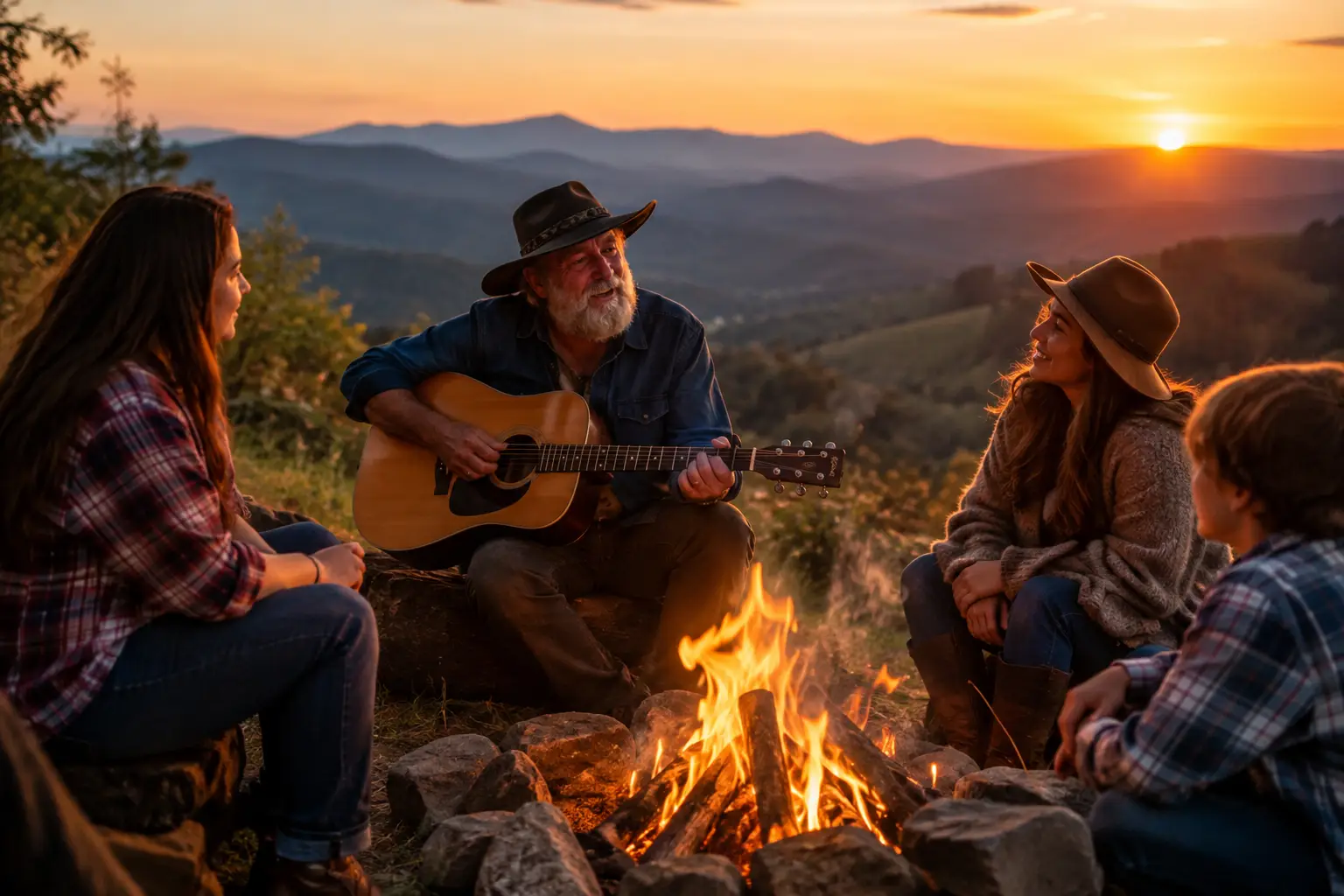
In Appalachia, stories do not only get told. They get sung. Ballads, bluegrass songs, gospel numbers, fiddle tunes, and old-time music have carried love, loss, labor, faith, family feuds, travel, and homecoming across generations.
A ballad can hold a whole life in a few verses. A fiddle tune can bring back a face, a kitchen, or a Saturday night dance long after the people there are gone. That is why traditional music deserves more than polite applause at a festival. It is a working archive of feeling and memory.
The same goes for the way people talk. Local sayings, nicknames, turns of phrase, and mountain humor hold history too. Preserving them does not mean pretending nobody can change or that every old custom was perfect. It means recognizing that language carries a people’s rhythm. Sand it down too much, and you lose some of the music.
Keeping the Tradition Alive Without Putting It in a Display Case
There is a trade-off in preservation. Record a story, and it may survive for grandchildren who live states away. But pull it too far from its context, and it can become a prop for somebody else’s idea of mountain life.
The respectful approach is simple, even if it takes effort. Give storytellers credit. Ask permission before recording or posting family tales. Keep the speaker’s voice intact instead of translating every sentence into polished, flavorless language. And do not treat a person’s accent like a costume for a cheap joke.
Young people have a role here, too. They do not have to quit using technology or move back to a cabin with no Wi-Fi to carry the tradition forward. They can record Grandma telling the real version of how she met Grandpa. They can ask an uncle about the first job he ever had. They can learn an old song, write down family sayings, or sit still long enough to hear why a certain creek, cemetery, or ridge matters.
A phone can be a distraction, sure. It can also be a pocket-sized archive if somebody uses it with respect.
Why These Stories Reach Far Beyond the Mountains
You do not have to be born in Appalachia to understand the power of stories passed hand to hand. Farm families in the Midwest, ranchers out West, shrimpers on the Gulf, and small-town folks in every corner of America know the same kind of memory. There is always a person who can tell you how the town used to be, who built the old bridge, what happened during the flood, and which neighbor would give you the shirt off his back.
That is why mountain storytelling belongs in the larger American conversation. It reminds us that ordinary people are not ordinary at all when somebody takes time to listen. A family recipe, a coonhound story, a hymn sung off-key at a funeral, or a tale about making do with less can hold more truth than a stack of polished speeches.
Backwoods America was built for that kind of truth: real people, real places, and the kind of stories that smell a little like woodsmoke, coffee, and muddy boots by the door.
The next time an older neighbor starts a sentence with, “Now, I don’t know if I ever told you this,” do not rush them along. Pull up a chair. Put the phone down for a minute, unless you have permission to record it. Ask one more question. Somewhere in that story may be a lesson, a laugh, or a piece of home that nobody else knows how to carry.