
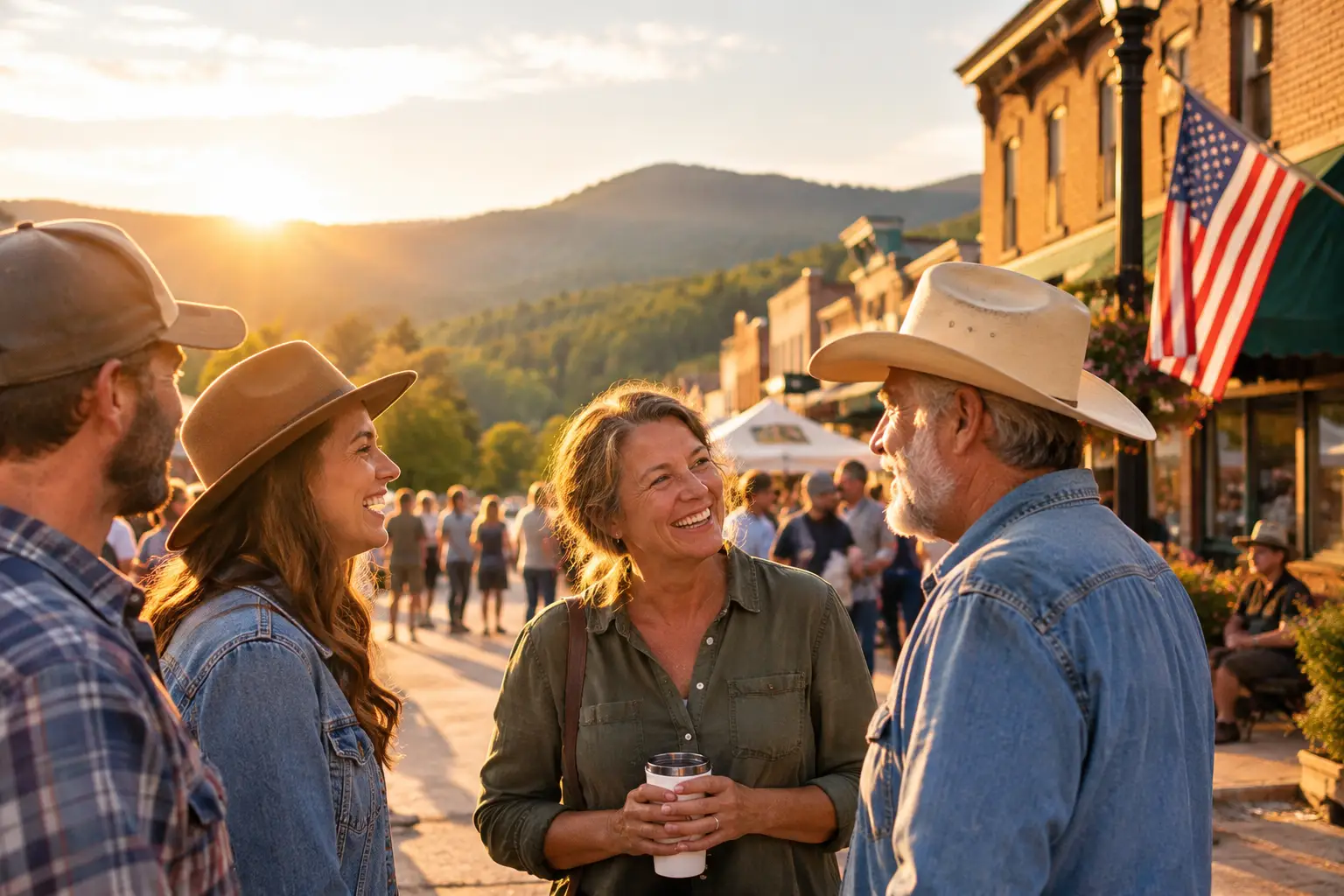
The fire truck rolls out for the homecoming parade, the high school band is a half-step behind the beat, and somebody’s grandma has already claimed the best folding-chair spot on Main Street. That right there is a piece of why small towns thrive. It is not because life is perfect, or because everybody agrees on every blessed thing. Small towns thrive because, when something matters, people show up.
They show up with casseroles after a hard week. They show up for a benefit supper, a ball game, a volunteer fire department raffle, a grand opening, and a neighbor whose fence got flattened by a storm. Folks may fuss about the price of feed, the pothole by the post office, or who forgot to return the church fellowship-hall key. But when the chips are down, they know whose pickup to call.
That kind of connection is not old-fashioned fluff. It is a strength many places are trying mighty hard to rebuild.
Why Small Towns Thrive Starts With Knowing People
In a small town, people are more than profiles, customers, or faces passing by in a parking lot. They are the mechanic who got your truck running before work Monday morning. They are the school secretary who remembers your kid’s name, the lady at the diner who asks about your mama, and the fellow down the road who has a tractor when your own equipment decides to act possessed.
That familiarity comes with responsibility. If you make a promise, people remember it. If you treat somebody wrong, word can travel faster than a June bug toward a porch light. But the flip side is just as powerful: if you keep your word, work hard, and lend a hand, your reputation becomes something money cannot buy.
A town does not need every resident to be best friends. Good Lord, that would be exhausting. It does need enough trust for people to cooperate when it counts. That might mean watching a neighbor’s place while they are away, coaching Little League, serving on the town council, or simply checking in when somebody has been quiet for a few days.
Local Businesses Keep More Than the Lights On
The hardware store, feed store, cafe, barber shop, antique booth, bait shop, auto garage, and family-owned distillery do more than sell goods and services. They give a town places to gather, swap news, solve problems, and put dollars back into the community.
Buying local is not about pretending every hometown shop can carry everything under the sun or beat every big-box price. Folks have budgets. People need choices. That is real life. But when a local business earns your trust, backing it matters. The money helps pay a local employee, supports a family, and keeps a storefront from going dark on the square.
Small-town entrepreneurship also has a plainspoken kind of courage to it. It is the couple turning a rundown building into a bakery. It is the welder taking on apprentices. It is the musician booking local gigs, the craft maker setting up at a festival, and the farm family finding a new way to sell what they raise. These are not side stories. They are how communities create opportunity without waiting for somebody else to save them.
A thriving town makes room for both heritage and fresh ideas. The old courthouse and the new coffee counter can get along just fine. Bless your heart, they may even need each other.
Traditions Give People a Reason to Come Home
Ask folks what they miss after moving away, and they rarely start with a building. They talk about Friday night lights, the county fair, the fishing hole, the Christmas parade, the bluegrass jam, the volunteer fireman’s fish fry, or that one fall festival where everybody somehow winds up eating too much funnel cake.
Traditions are not just nostalgia with a better soundtrack. They create a shared calendar. They tell kids, newcomers, and old-timers alike: this is who we are, and there is a place for you here.
That is especially important when a town is trying to hold onto its young people. A young person may leave for college, training, military service, or a job opportunity. That does not mean they have abandoned their roots. Towns that thrive give them reasons to stay connected and reasons to return. Maybe it is a family business, affordable space to start something new, nearby outdoor country, or simply the knowledge that home is still a place where they are known.
The strongest traditions are not museum pieces. They can grow. A longtime harvest festival can add local artists. A country music night can welcome a younger band. A historic downtown can host food trucks alongside the diner that has served pie for forty years. Keeping the soul of a place does not require freezing it in time.
Small Town Life Has Trade-Offs, and Folks Know It
Let’s not paint every gravel road gold. Small-town life can come with fewer job options, longer drives for medical care or shopping, spotty internet, tight housing, and the occasional feeling that everyone knows your business before you do. Some communities have struggled for years with population loss, shuttered factories, or young families being priced out.
Pretending those challenges are not real does rural America no favors. Pride without honesty is just a bumper sticker.
But adversity can sharpen a community’s instincts. When resources are limited, people learn to repair, reuse, barter, organize, and make do. They learn that waiting around for a miracle is usually less useful than gathering a crew, making a plan, and getting their boots dirty. That self-reliance does not mean going it alone. It means knowing how to carry your share while standing beside others.
Not every town will thrive in the same way, either. One may build around agriculture, manufacturing, tourism, outdoor recreation, or heritage crafts. Another may become a good place for remote workers who want room for a garden and a quieter life. There is no one-size-fits-all blueprint, and anyone selling one ought to be watched closer than a raccoon near the chicken coop.
The Secret Is Participation, Not Perfection
A town is not saved by a slogan on a water tower. It is strengthened by people who participate.
That can look ordinary: attend the school play, thank the volunteer firefighters, buy a ticket to the benefit, vote in local elections, welcome a new family, and speak up with respect when something needs fixing. It can also mean taking a bigger swing – opening a business, restoring a building, organizing an event, mentoring a kid, or serving where the work is hard and the applause is scarce.
The country code has always understood this. You do not have to be rich, famous, or connected to make a difference. You have to be dependable. You have to care enough to show up more than once.
That is why the best small towns do not merely survive on memories. They build on them. They honor the old ways of loyalty, hospitality, faith, work, and neighborliness while making room for the next generation to add its own chapter.
A thriving small town may have one blinking traffic light, a stubborn old courthouse clock, and a cafe where the coffee has seen things. But if its people keep choosing one another – at the ball field, in the business district, after a storm, and around the kitchen table – it has something plenty of bigger places are still searching for. Keep showing up, y’all. That is how a town becomes home.