

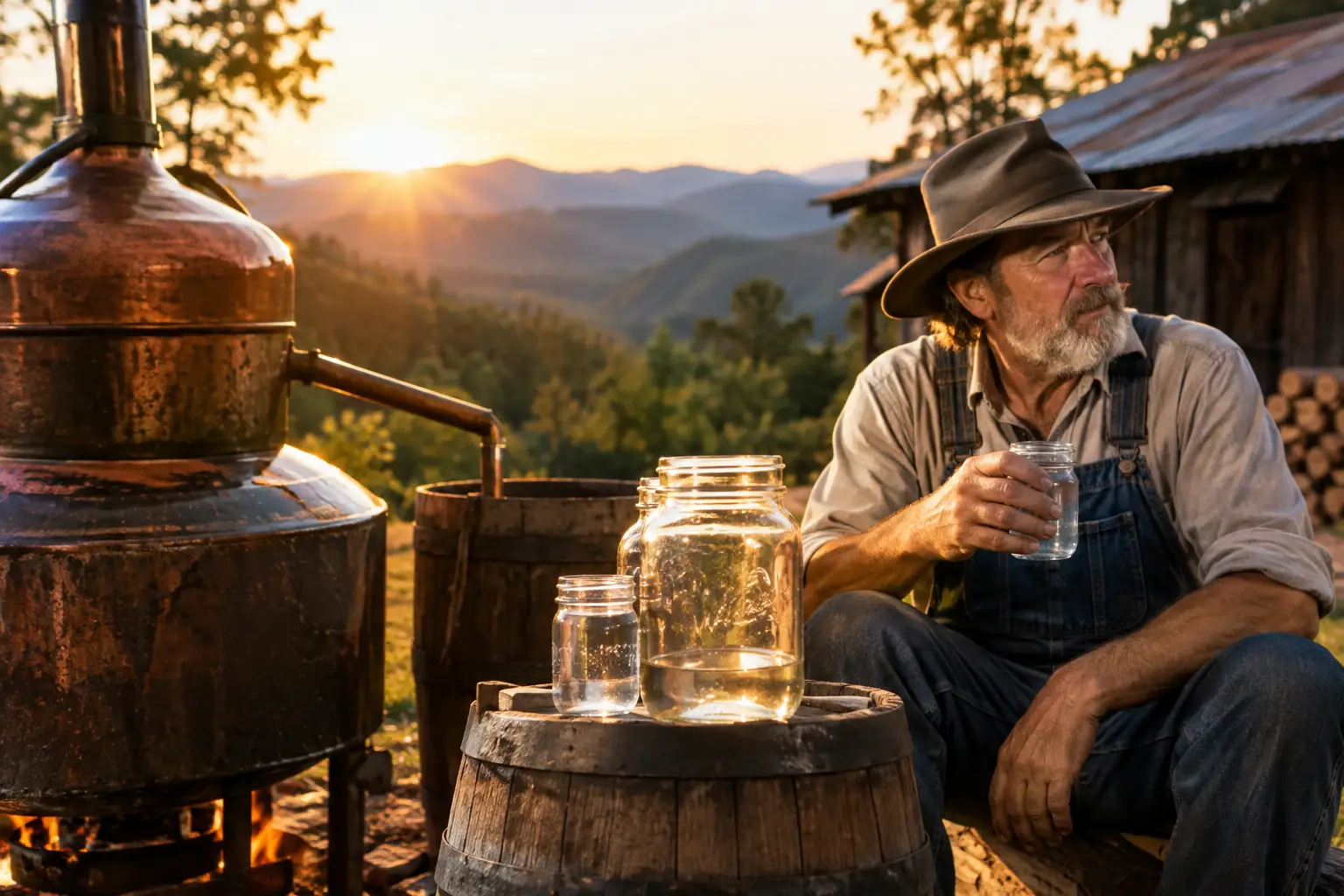
A copper still hidden beyond a creek, a lookout on a ridge, a mason jar catching the light – that picture is part of America’s memory. But the history of moonshining in America is bigger than outlaw tales and TV catchphrases. It is a story about taxes, independence, family survival, government power, mountain know-how, and folks making do when cash was scarce and work was hard to find.
Moonshine has been romanticized plenty. It has also been mocked, commercialized, and flattened into a cartoon. The real story deserves better. It belongs to generations of Americans – especially in rural Southern and Appalachian communities, but also across farm country, the Midwest, and beyond – who carried old-world skills into a new country and made a living the best way they knew how.
Before Moonshine Had a Name
Distilling did not begin in a holler with a fast car waiting down the road. European settlers brought distilling traditions with them to colonial America. Grain was hard to haul, easy to spoil, and often worth more when turned into whiskey. A farmer could grow rye or corn, convert it into a shelf-stable spirit, and transport a smaller, more valuable product to market.
That practical math mattered on the frontier. Cash was often scarce, roads were rough, and communities lived far from banks, ports, and big-city buyers. Whiskey could be traded, sold, or saved. In some places, it worked almost like currency.
The word “moonshine” came to describe liquor made secretly, often by the light of the moon to avoid notice. It did not always mean bad liquor, and it surely did not mean every country family had a hidden still. But it became a catchall name for untaxed, unlicensed spirits made outside the law.
The History of Moonshining in America Starts With Taxes
After the Revolutionary War, the young federal government needed money to pay its debts. In 1791, Congress placed an excise tax on distilled spirits. On paper, it was a revenue measure. Out on the western frontier, many small producers saw it as a punishment aimed square at people who relied on whiskey to get by.
The result was the Whiskey Rebellion. Farmers and distillers in western Pennsylvania resisted tax collectors, sometimes violently. President George Washington called up militia forces, and the rebellion faded without becoming the full-blown war some feared.
Still, the argument never really disappeared: Who gets to decide what a working person can make, sell, and keep? For rural Americans, whiskey taxes often felt like distant lawmakers reaching into a cabin, a barn, or a family’s winter provisions. Ain’t that the truth – a fight over a jug of liquor was often a fight over power and survival.
The Mountain Trade Grows
During the 1800s, untaxed distilling spread in areas where geography made enforcement difficult and where small farms depended on every possible source of income. The Appalachian region became strongly associated with moonshine, partly because isolated terrain offered cover and partly because corn was plentiful. But illegal distilling was never limited to one mountain range or one kind of person.
The Civil War era brought another federal liquor tax in 1862. That tax helped fund the war, but it also expanded the conflict between illicit distillers and revenue officers. Federal agents, often called “revenuers,” were charged with finding illegal operations and collecting taxes. Their work could be dangerous. So could the work of the families they pursued.
There is no need to turn that history into a hero-and-villain cartoon. Some moonshiners were honest people trying to keep food on the table. Some produced unsafe liquor or got tangled up in violent criminal activity. Some agents acted with courage; some enforcement efforts were heavy-handed and deepened distrust. Real history is usually muddier than a backroad after three days of rain.
For many families, the knowledge itself became heritage. Recipes, yeast practices, timing, and equipment skills were guarded closely. Not because everyone was looking for a thrill, but because a family trade could mean the difference between making it through and falling behind. That kind of self-reliance still rings familiar in small towns all over America.
Prohibition Put the Whole Country in the Game
When national Prohibition began in 1920, legal alcohol production and sales were largely banned across the United States. That changed the scale of moonshining overnight. Illegal liquor was no longer just a rural tax issue. It became a nationwide business, feeding demand from city speakeasies to small-town gatherings.
Bootleggers, smugglers, organized crime groups, and everyday folks all found ways around the law. Rural distillers supplied part of that market, but the Prohibition story is much bigger than hidden stills in the woods. Rum running, industrial alcohol diversion, counterfeit labels, and urban distribution networks played major roles too.
Prohibition ended in 1933, but illegal moonshining did not disappear. Legal alcohol came with permits, regulations, and taxes. For families already skilled at making spirits outside that system, the old trade remained tempting. Demand remained, too.
That is one reason the moonshine era stretched far beyond the flapper dresses and jazz clubs folks usually picture when they think of Prohibition.
Fast Cars, Folk Heroes, and the NASCAR Connection
By the mid-20th century, some moonshine runners became known for modifying cars to carry illegal liquor while outrunning law enforcement. They strengthened suspensions, tuned engines, and learned every curve on local roads. Those driving skills and mechanical tricks became part of Southern racing lore.
There is a real connection between moonshine runners and early stock-car racing, including NASCAR’s beginnings. Several early drivers, car builders, and fans came from that world. But the tale gets oversold sometimes. NASCAR was not simply built by moonshiners, and every racer was not hauling liquor on Friday night before racing on Sunday. The truth is still plenty colorful without adding a coat of tall-tale paint.
What mattered was the culture of ingenuity. Folks with limited resources made machines go faster, last longer, and handle rough roads better. That same hands-on spirit is why country people have long been builders, fixers, racers, farmers, welders, mechanics, and problem-solvers. Give a determined man or woman a tool shed and a reason, and Good Lord, something useful is likely to happen.
From Hidden Stills to Legal Distilleries
Today, the word moonshine sits in an interesting place. It can mean illicit homemade liquor, especially in a historical sense. It can also appear on a legal bottle made by a licensed distillery and sold with taxes paid, labels approved, and safety rules followed.
That distinction matters. Legal distilleries are preserving pieces of regional flavor and family history while operating openly and responsibly. Many produce unaged corn whiskey, which is often marketed as moonshine because of its cultural roots and clear appearance. It may honor old traditions, but it is not the same thing as illegal liquor made in secret.
The modern revival has brought both pride and questions. It is good to see local ingredients, traditional craftsmanship, and rural stories receive respect. At the same time, a mason jar on a shelf does not automatically make something authentic. Heritage is more than a label. It is the people, places, work, and hard-earned knowledge behind it.
Why the Story Still Matters
The history of moonshining in America is not an invitation to break the law, and it should never be used to excuse unsafe alcohol. It is a reminder that rural people have always found ways to endure, adapt, and protect their families when the deck was stacked against them.
It also reminds us to look past easy stereotypes. Country folks are not props for a punchline, and mountain communities are not museum pieces. They are living places full of teachers, veterans, farmers, nurses, mechanics, artists, business owners, and neighbors who show up when somebody needs help.
So when you see an old copper still in a museum, hear a racing story passed around at a cookout, or spot a legal moonshine jar at a local distillery, remember what is sitting behind it: a long American story of grit, controversy, craftsmanship, and survival. Treat that heritage with respect, support legal makers who do things right, and keep asking the older folks in your family what they remember. Some of the best history in this country is still waiting on a porch, just hoping somebody will pull up a chair.
Pingback: How to Identify Legal Moonshine Without Guesswork - BACKWOODS AMERICA